Seven Minas Gerais farms recorded costs below a state benchmark and yields above the national average, though the small study can’t establish cause and effect.
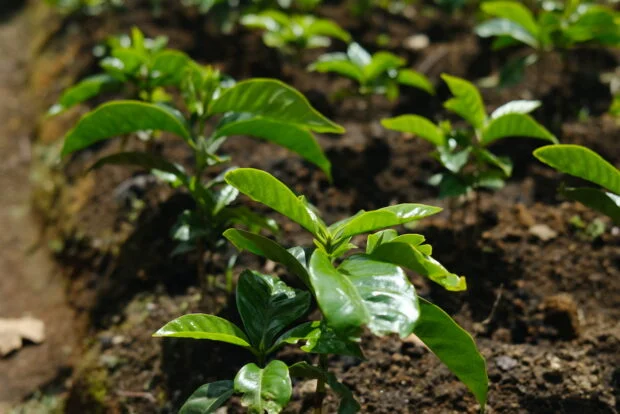
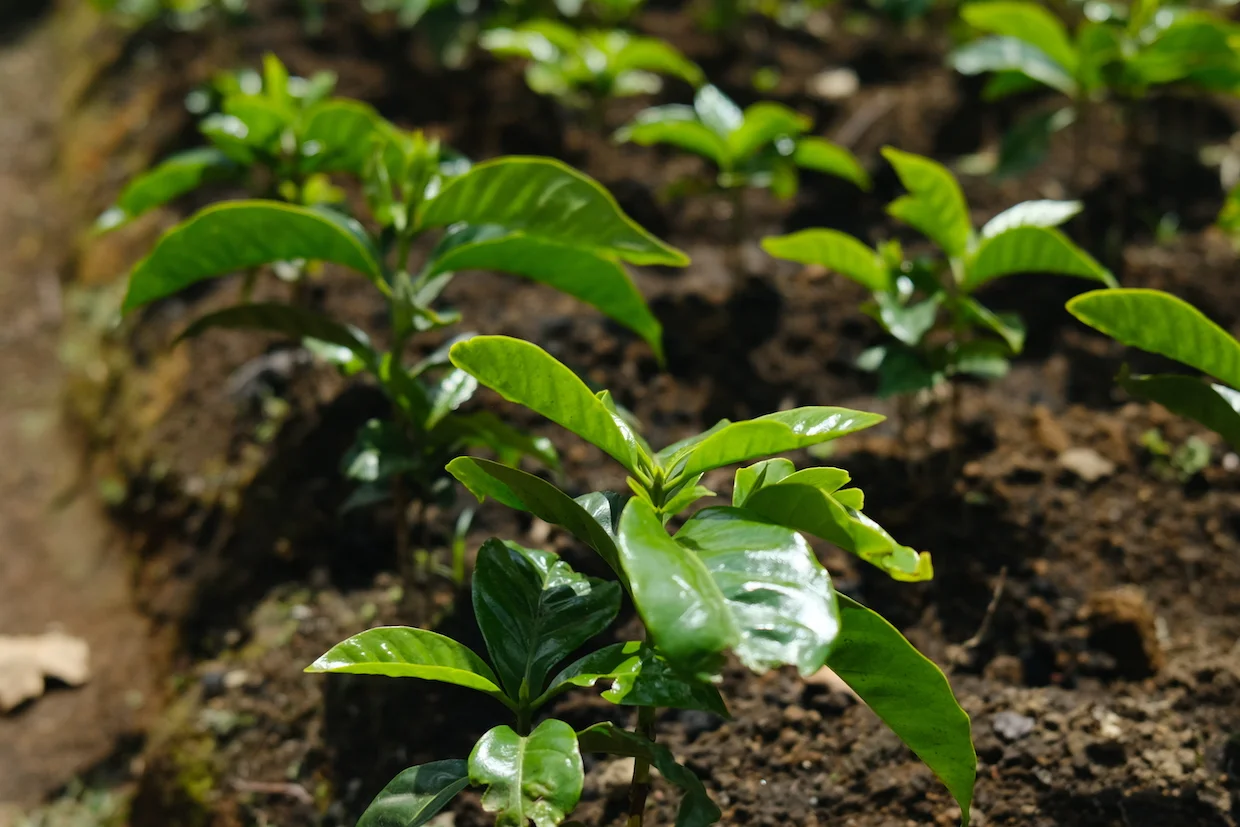
Coffee seedlings in soil. Daily Coffee News photo by Nick Brown.
Seven farms offer a useful but narrow test
Seven coffee farms in Brazil’s Minas Gerais state offer a promising but limited data point for regenerative agriculture: their operating costs were below a state benchmark, and their average yields topped a national figure. The results suggest that farms using regenerative practices can maintain competitive production. They don’t establish that those practices caused the lower costs or higher yields, a distinction that matters when growers and buyers weigh claims about the economics of changing farm management.
The Brazil program of the Global Coffee Platform examined the economic, agronomic and environmental performance of arabica farms in South of Minas and Cerrado Mineiro. Four farms were predominantly mechanized; three relied mainly on manual labor. Each used at least one regenerative practice, including organic soil inputs, non-synthetic fertilizers or ground cover such as cover crops. Those differences make the farms useful for exploring how varied practices operate under different conditions, but they also make it harder to isolate the effect of any one practice.
That range of farm conditions matters. As GCP Brazil Program Director Pedro Ronca said in the study announcement, “different combinations of regenerative practices can deliver competitive production systems, provided they are adapted to the conditions of each farm, implemented consistently and supported by technical guidance.” The qualification is central: the study’s message is less that there’s a single regenerative formula than that results depend on local choices and sustained management.
Costs and yields offer an encouraging signal
Effective operating costs ranged from R$488.41 (US$94.87) to R$745.61 (US$144.83) per 60-kilogram bag. Each figure was below the March 2025 Minas Gerais benchmark of R$768.80 published by Brazil’s National Supply Company (CONAB). The gap suggests that the farms were operating below a relevant state reference, though a comparison with a benchmark can’t explain why: farm scale, labor model, site conditions and other management decisions may also shape costs.
The regenerative plots averaged 45 bags per hectare, compared with CONAB’s 2025 national average of 30.4 bags per hectare across arabica and robusta. That’s a striking difference, but the figures describe different populations and don’t amount to a controlled comparison. The case study doesn’t establish that regenerative practices produced lower costs or higher yields. Its seven farms also aren’t a representative sample of Brazil’s coffee sector, much less producers in other countries.
This is more significant than it looks, but only as an early signal. A small group of farms can show that certain practices coexist with competitive results; it can’t show how often that pattern holds, or what trade-offs growers might face elsewhere. If you’re working in this space, the useful question is what conditions explain the results and whether those conditions can be identified across a wider set of farms.
Soil constraints lie below the surface
Soil tests point to a practical priority for farm management. Conditions in the upper 20 centimeters were generally favorable, but samples from 20 to 80 centimeters showed issues with calcium and magnesium balance, aluminum saturation and other factors that could restrict root growth and access to water and nutrients. The contrast suggests that a healthy-looking surface can conceal constraints deeper in the soil profile, where roots must reach to draw on moisture and nutrients.
Similar constraints appeared in both regenerative and reference plots. That makes the finding relevant to management across the farms, rather than a problem tied only to the regenerative plots. The study’s authors identify deeper soil fertility as one of the strongest opportunities to improve drought resilience, production stability and productivity. Here’s the thing: surface indicators alone may miss limitations that affect how reliably a crop can access resources through changing conditions.
For growers, the result points toward site-specific assessment and technical guidance, consistent with Ronca’s emphasis on adapting practices to each farm. It doesn’t prescribe a particular remedy or show which intervention would work best. More useful comparisons over time could help clarify whether changes in deeper soil conditions accompany changes in resilience and production.
Modeled carbon balance and emissions sources
Analyses by Solidaridad, using the Cool Farm Tool, estimated that carbon removals exceeded emissions across the production systems modeled at all seven farms. That’s a result about the systems represented in the analysis, not a measurement of every farm’s full environmental impact or a sector-wide estimate. The distinction matters because modeled balances depend on what the analysis includes and how farm practices are represented.
Synthetic nitrogen fertilizer represented 46% of modeled greenhouse-gas emissions. Agricultural residue management—including coffee husks, leaves and pruning material—accounted for another 37%. Together, the categories identify areas that could shape future farm-level emissions work, while leaving open which changes would reduce emissions without undermining production or soil management.
Those shares give the findings a practical edge: they point to specific parts of farm operations that merit closer measurement. And this is the part most people overlook: an emissions profile can help set priorities, but it doesn’t by itself demonstrate that a proposed change will improve the overall balance. That requires tracking both the intervention and its effects in the field.
Implications for monitoring beyond the pilot
JDE Peet’s supported the research, with participation from Solidaridad, Cooxupé, Emater-MG and individual technical experts. GCP Brazil describes the work as the start of a reference-farm and monitoring system that could extend to other regions and production models. A broader system could help compare results under more varied conditions, though its value would depend on consistent methods and enough context to interpret differences among farms.
The field observations complement earlier, largely modeled work on regenerative coffee. TechnoServe examined the economics of regenerative agriculture in coffee, while a later analysis found that costs and benefits vary with farm size, country and starting conditions. Read together, the work points to a recurring constraint in the debate: broad claims can obscure how strongly results depend on where and how a farm operates.
GCP Executive Director Annette Pensel said evidence gathered collectively and before competition can help the sector invest with confidence. For now, the seven farms make the case for more farm-level measurement. Their results are encouraging, while broader monitoring will show how well they hold across different growing conditions and production models. More evidence is needed before these findings can be treated as a reliable guide for coffee producers beyond the farms studied.
Promising, but still preliminary.


Discussion
Sign in to join the discussion.