A review of wild robusta ecology questions whether today’s irrigated farms can sustain production as the climate changes.
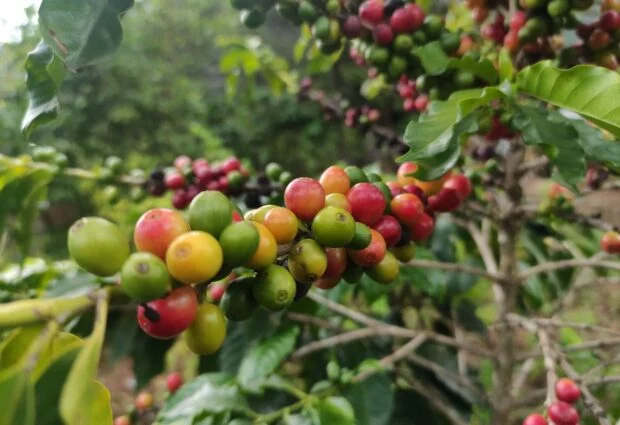
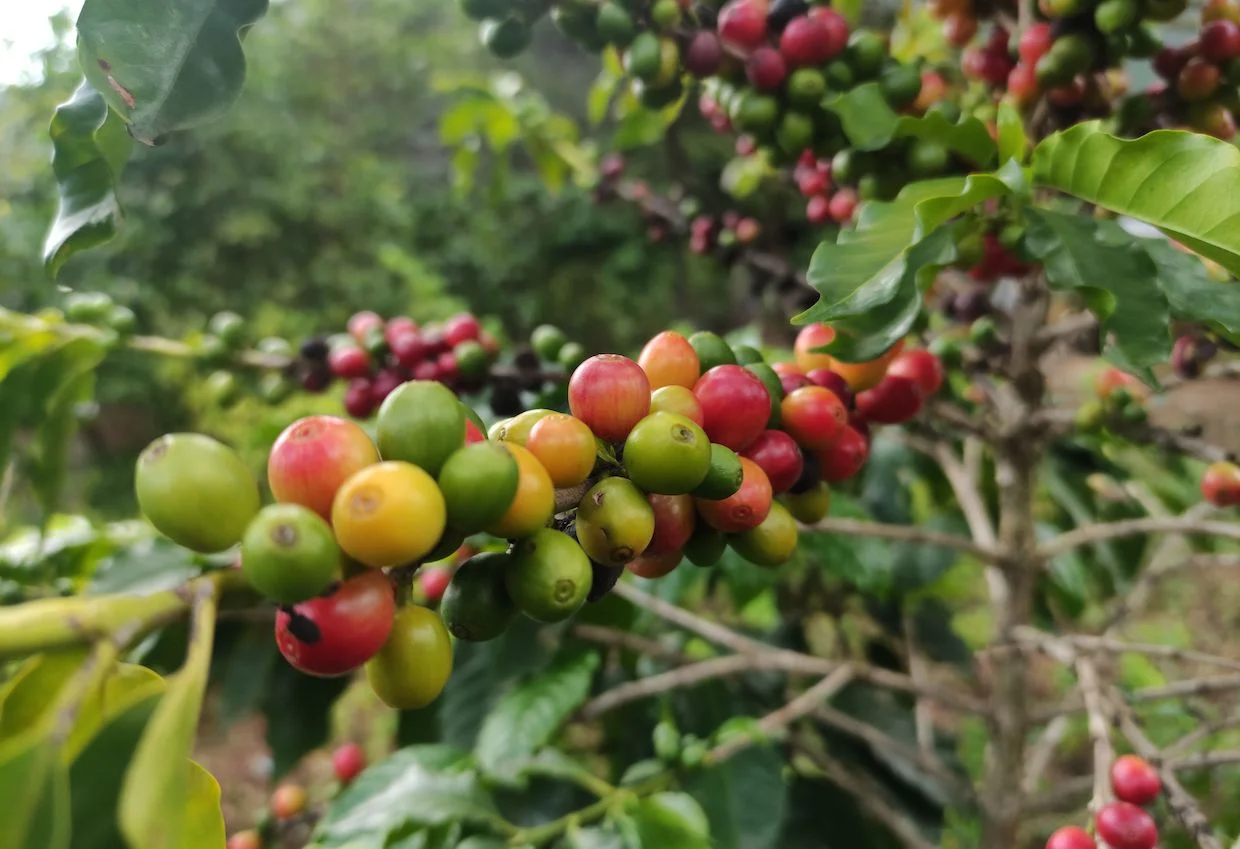
Robusta’s rising share of coffee production doesn’t guarantee it can serve as a climate-safe fallback for arabica. A new review led by Aaron Davis of Royal Botanic Gardens, Kew, argues that much of the robusta grown in major producing regions depends on irrigation, complicating claims that the crop is naturally suited to a hotter, drier future. The distinction matters: a crop can be grown under challenging conditions with enough water supplied by farms, but that doesn’t establish that it can thrive as rainfall becomes less reliable.
Published Aug. 27 in Sustainable Development, the open-access review was co-authored by Akshay Dashrath of SICC Labs in India and Kew researcher Justin Moat. The authors conclude that “climate resiliency claims for farmed robusta are misguided.” Their argument is less that robusta has no role in coffee’s future than that its reputation for resilience rests on an incomplete reading of where the species grows and what supports it there.
Wild robusta depends on water beyond rainfall
The researchers reviewed more than a century of studies and analyzed water availability near wild robusta populations in Africa. They found the species in warm tropical environments where water tends to remain accessible through much of the year, supplied not only by rain but also by rivers, wetlands, groundwater and high water tables. In other words, warm conditions alone don’t explain where wild robusta persists; the surrounding sources of water are part of the picture.
That ecology complicates climate models built largely around temperature and rainfall. Such models may classify irrigated farms or naturally water-rich sites as evidence that robusta can flourish in drier conditions, the authors argue. But irrigation can mask a crop’s dependence on water, while a site with groundwater or nearby wetlands may have a water supply that rainfall figures don’t capture. “We contest that this proposition is not supported by scientific evidence,” they wrote of the idea that cultivated robusta offers a straightforward way to maintain global coffee output as the climate changes.
The distinction matters because leading production areas in Vietnam, Brazil and India don’t necessarily have the natural water conditions wild robusta favors. In northern Espírito Santo, Brazil’s principal robusta-producing state, about 90% of the crop is irrigated. That figure points to a practical dependency: production there is supported by active water management, so its performance can’t be treated as proof that robusta will be a low-input option in hotter, drier regions.
Production scale raises the stakes
Robusta represents roughly 43% of global coffee trade, according to figures cited in the paper. Brazil and Vietnam together account for about 65% of robusta exports. Those shares make the crop’s water needs more than a question for individual growers. If production depends on irrigation across important growing areas, expansion can put greater demands on local water supplies and complicate claims that shifting from arabica to robusta is a simple response to climate pressure.
The authors say those practices conflict with ecosystem and biodiversity stewardship and with efforts to reduce carbon emissions. They also point to low tree-shade cover and heavy synthetic fertilizer use as concerns alongside irrigation. These pressures can reinforce one another: intensive cultivation may support output in the short term while increasing the environmental costs of producing it. The review doesn’t quantify those costs in the article’s cited figures, but it argues that they belong in any serious assessment of robusta’s climate credentials.
The issue is already visible in Vietnam’s Central Highlands, where the environmental costs of the robusta boom have drawn scrutiny. That experience offers a useful caution for other producing regions: rising demand and favorable crop performance don’t, by themselves, show that an expansion can be sustained without straining water and ecosystems. (And this is the part most people overlook.) A climate strategy that counts hectares but doesn’t account for how farms secure water can mistake managed production for natural resilience.
The review doesn’t call for the industry to walk away from robusta. It points instead to expansion in locations whose water and temperature conditions better fit the species, changes to cultivation practices, and climate-focused crop development. More detailed climate mapping will be needed to identify where rain-fed production can grow sustainably. That work would help distinguish areas where robusta’s natural conditions align with farming from places where yields may depend on irrigation and other costly interventions.
Broadening coffee’s options
Davis has also studied coffee species beyond arabica and robusta as climate pressures and limited genetic diversity threaten production. Kew researchers established last year that liberica and excelsa are genetically distinct species, a finding with potential implications for commercial cultivation. In May, a Kew team led by Davis proposed Coffea × libex as the name for hybrids between the two. These developments broaden the discussion from choosing between the two dominant commercial species to understanding whether less familiar coffee plants could contribute useful traits or new cultivation options.
That possibility remains a research direction, not an established replacement for major crops. Commercial cultivation depends on more than a species’ ability to grow: growers and buyers also need reliable production and a reason to adopt it. Still, wider study of coffee’s genetic diversity may give breeders more material to work with as climate conditions shift. It’s a sensible hedge against relying too heavily on a narrow range of varieties, though the review’s central argument remains focused on matching robusta to the water conditions it actually needs.
What the findings mean for coffee production
This is more significant than it looks. Robusta is often presented as the practical answer to climate stress because it can grow in warmer conditions than arabica. The review challenges the leap from that observation to a broader promise of climate safety. If you’re working in this space, the useful question isn’t simply whether a crop tolerates heat; it’s whether the water and cultivation systems needed to grow it can be maintained where production is expected to expand.
For growers and planners, that means climate assessments need to account for water sources and farming practices as well as temperature and rainfall. It also means that “rain-fed” production should be distinguished from production that relies on irrigation to compensate for local conditions. The numbers here are underwhelming as a simple resilience story: large-scale output doesn’t prove that a crop can withstand a drier future on its own.
The review was funded by the Calleva Foundation and the Amar-Franses Foster-Jenkins Trust in the UK. Its practical message is that robusta’s future depends on matching production to the species’ actual water needs; acreage and climate models alone can’t establish resilience. More precise maps, changes in cultivation and broader crop research may all help. The harder task is making sure that plans to preserve coffee output count the water and environmental conditions behind that output. Better fit between crop and place. That’s the test the industry still has to meet.


Discussion
Sign in to join the discussion.