Australian researchers built a graphene oxide membrane that cuts about 47% of caffeine from prepared coffee, though taste and scale questions remain open.
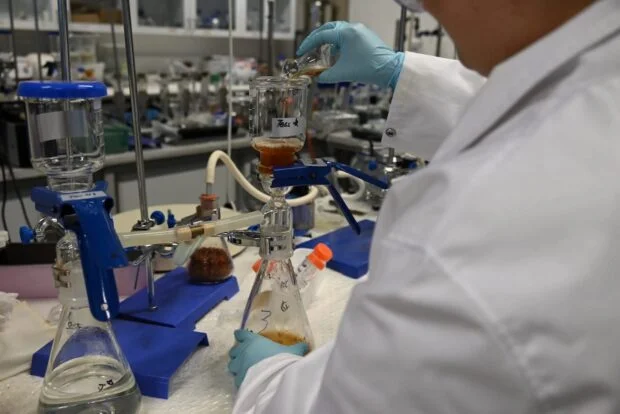
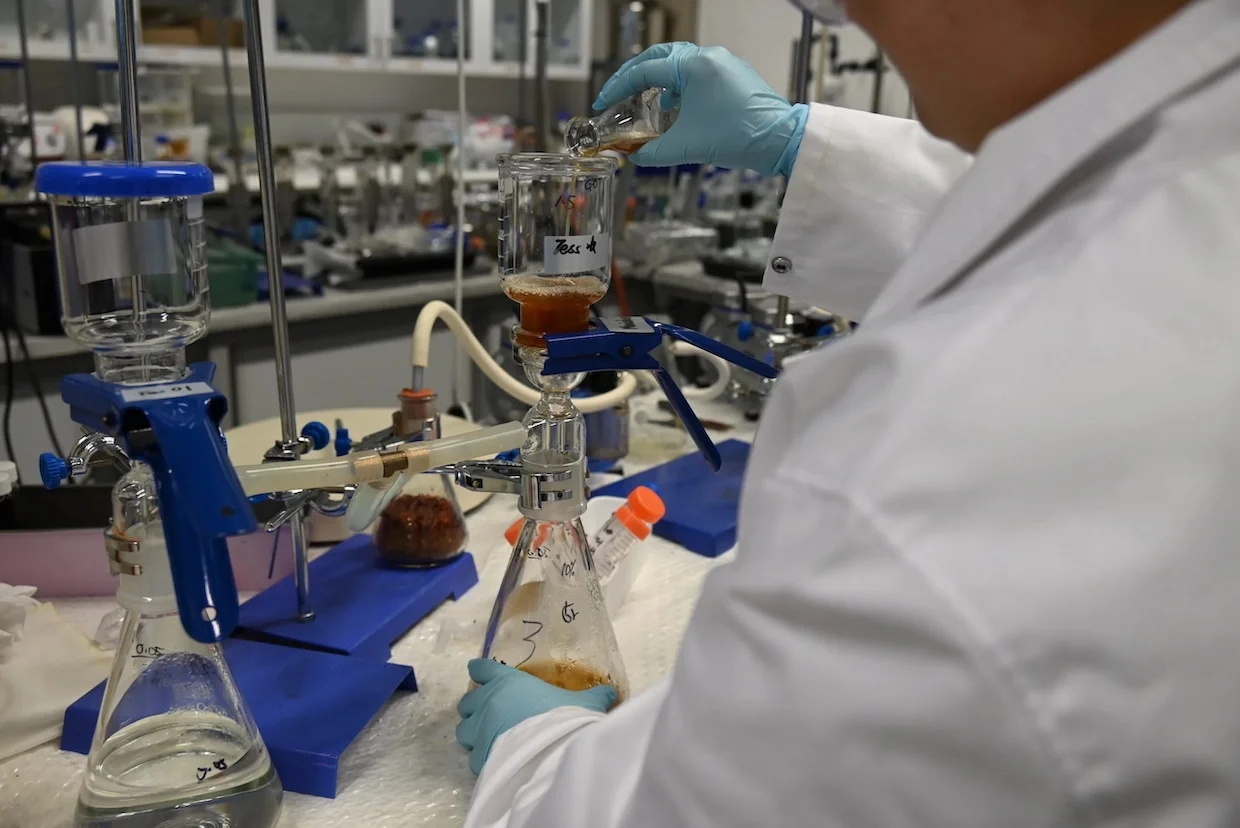
ARC Centre of Excellence for Carbon Science and Innovation news photo.
Almost every decaf on the market loses its caffeine before roasting, through water, carbon dioxide or solvents. A team in Australia is testing the opposite sequence: pulling caffeine out of coffee that's already been made. Its experimental membrane removed roughly half the caffeine from the liquid, which is a striking result for a filter that's still at the prototype stage. Don't mistake the prototype label for a footnote, though. It's the most important word in the story.
Here's the thing: the order matters more than it sounds. Green beans are the usual target because they're stable, easy to store and well understood by the industry. Taking caffeine out of a finished cup is a different problem entirely. You're working with a liquid packed with acids, sugars and aromatic compounds, and every one of them is looking for a way through whatever barrier you build. (And this is the part most people overlook: by the time coffee is brewed, roasting has already reshaped its chemistry, so anything you remove now comes out of a far more complicated mixture.)
The study, published in September in the Journal of Membrane Science, describes a membrane built from graphene oxide, an ultra-thin carbon material. It cut caffeine concentration by about 47%. The authors are careful about what that number means. They called the work an "early-stage demonstration" and wrote that "the present permeance remains modest under real-coffee filtration conditions." In other words, this isn't a factory process yet. I read that caution as the honest reading of the data rather than false modesty. Lab results on membranes often look far better than they behave once someone tries to run them at volume, and the authors seem to know it.
The research was led by Yihan Tian at the University of New South Wales, with collaborators at Okayama University in Japan and support from the Australian Research Council's Centre of Excellence for Carbon Science and Innovation. Work like this tends to cross disciplines. Membrane design sits in materials chemistry, while judging whether the filtered coffee is still coffee sits in food science. A project that spans both isn't unusual, but it does mean the people who understand the filter and the people who understand the drink have to agree on what success looks like.
How the Membrane Works
The team stacked graphene oxide into thin layers with microscopic channels running between them. Think of it as a pile of sheets with narrow gaps, where the size of each gap decides which molecules can slip through. To tune those gaps, they added calcium ions and sodium alginate, a compound extracted from seaweed. Those additions changed the size and chemistry of the channels, which is where most of the engineering effort in membrane work tends to go. The goal was simple to state: let caffeine pass and hold back the rest of the coffee.
For testing, the researchers diluted a commercial freeze-dried instant coffee rather than working with freshly brewed espresso or drip coffee. That choice makes sense for a first experiment, since instant coffee is consistent from batch to batch and easier to reproduce. It also means the results describe a simplified version of a real cup. Each flat-membrane run used 100 milliliters of solution, filtered for 24 hours at room temperature under vacuum. A day-long run is slow by any production standard, and the authors don't pretend otherwise.
Testing and What the Numbers Mean
The best membrane brought caffeine down from 24.64 to 12.95 micrograms per milligram of dried coffee solids, a 47.4% reduction. Trigonelline, N-methylpyridinium, choline and hydroxymethylfurfural all remained in measurable amounts. Those compounds shape coffee's chemistry and, in some cases, its flavor. Trigonelline, for example, is tied to roasting character, which is why its presence matters more than a raw caffeine percentage suggests.
Here's the catch: several of those compounds also dropped during filtration. The membrane isn't perfectly selective, and that's the trade-off every filter faces. And the team didn't run any sensory testing, so nobody knows how the cup actually tastes afterward. That's the gap that matters most to anyone who drinks coffee for pleasure rather than chemistry.
That said, the authors put the limits of their own data plainly. They wrote that "the performance of the membranes cannot be assessed by a single indicator." That's the right caution. A caffeine number alone tells you nothing about whether the coffee is still worth drinking. Consumers tend to notice bitterness, body and sweetness long before they notice milligrams, and a filter that removes caffeine while flattening those qualities would fail the people it's meant to serve.
Post-Brew Decaf Has Had a Rough Start
Post-extraction decaffeination hasn't gained much commercial ground, and the reasons aren't hard to guess. Brewed coffee is a messy, reactive liquid, and removing one compound from it without disturbing the rest is a harder engineering problem than treating beans in bulk. Seattle startup Decafino introduced a post-brew decaf pouch in 2022, claiming it could remove up to 80% of caffeine from prepared coffee in eight minutes. Its website is no longer running, and the company's current status is unclear. I'd treat that as a warning sign, not a verdict on the idea, but it's a warning all the same.
The membrane faces its own hurdles. The authors say the next work needs to speed up filtration, prevent clogging, define cleaning and reuse procedures and pin down operating costs. Each of those is a serious problem on its own. Clogging alone can end a filter's usefulness in a commercial setting, since coffee solids are exactly the kind of material that builds up on surfaces. The study also didn't show any energy or environmental advantage over established methods. A filter that wins on caffeine but loses on energy and cost won't displace anything yet.
What This Means If You're Brewing or Buying Coffee
If you're a home brewer, this research doesn't change your options this year. You can't buy a graphene oxide membrane off a shelf, and the closest thing to a post-brew decaf today is still the kind of pouch Decafino pitched. If you're a cafe owner or roaster, the more useful takeaway is about flexibility. Removing caffeine after brewing would let a cafe or consumer choose the strength of a cup without buying a separate bean, which is a practical appeal that the bean-based process can't match.
Still, the approach is worth watching. Most decaf is a compromise made upstream, before anyone knows how the final cup will taste. A post-brew method would move that decision to the point of consumption, and that's a meaningful shift in who controls the result. Whether a membrane can do that without flattening the flavor is the question the next round of research has to answer.
Where This Goes Next
The prototype has to clear three tests before anyone should call it a product: it has to filter quickly enough to matter, stay clean and reusable over repeated runs, and preserve the qualities that make a cup worth drinking. Right now it has passed only the first measurement, and only in a lab setting. The sensory work is the piece I'd watch most closely, because a membrane that cuts caffeine while leaving the flavor intact would be a different kind of result than one that cuts caffeine and leaves a thinner, less interesting drink behind.
Expect the next papers to focus on flow rate, fouling and cost before they focus on taste. That ordering makes sense from an engineering standpoint, but it also means the hardest question may come last. Don't be surprised if the first commercial attempts look more like niche products than a replacement for the decaf already on your shelf. Early technologies usually start small, and this one has a long way to go before it earns a place in the mainstream.


Discussion
Sign in to join the discussion.